
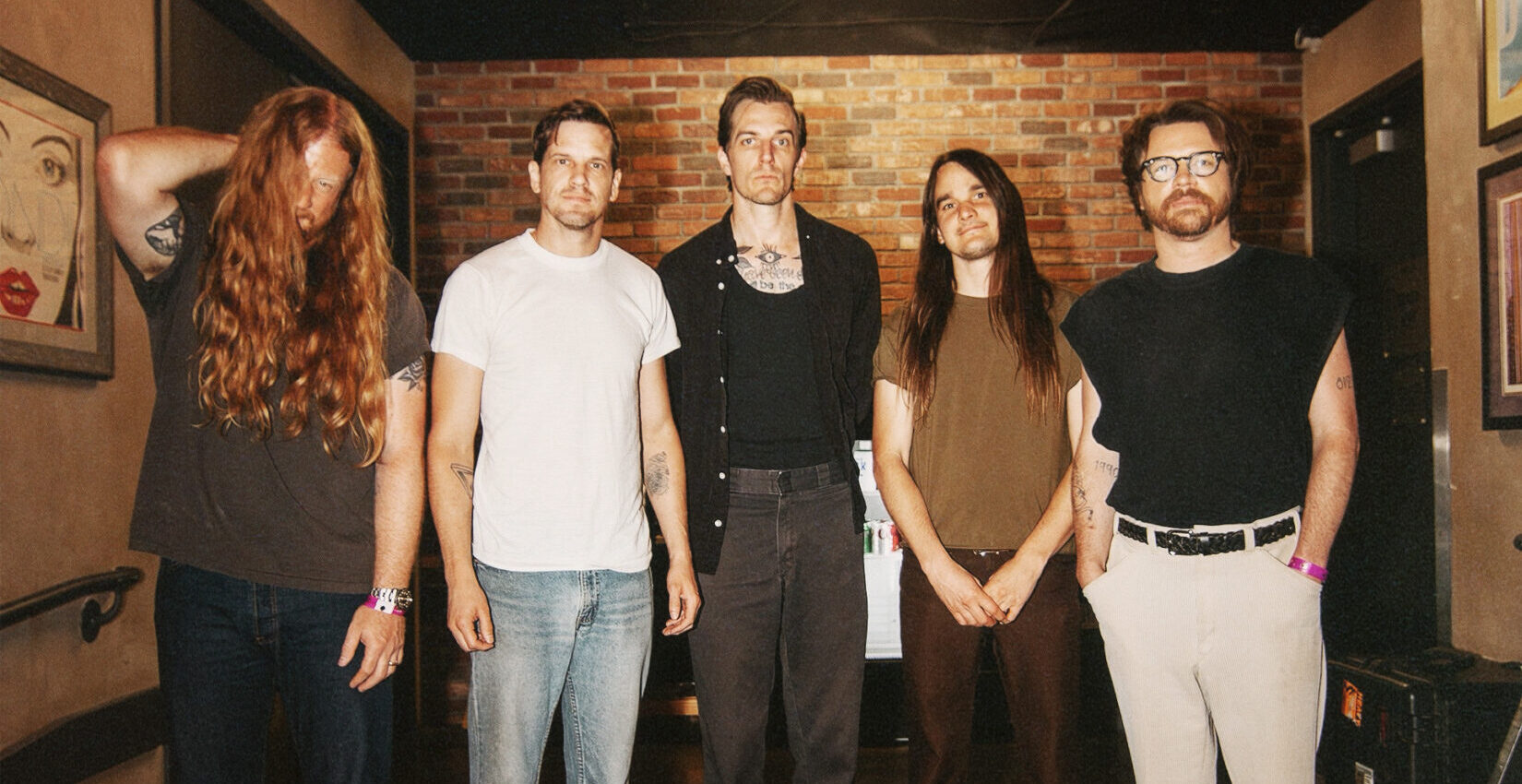
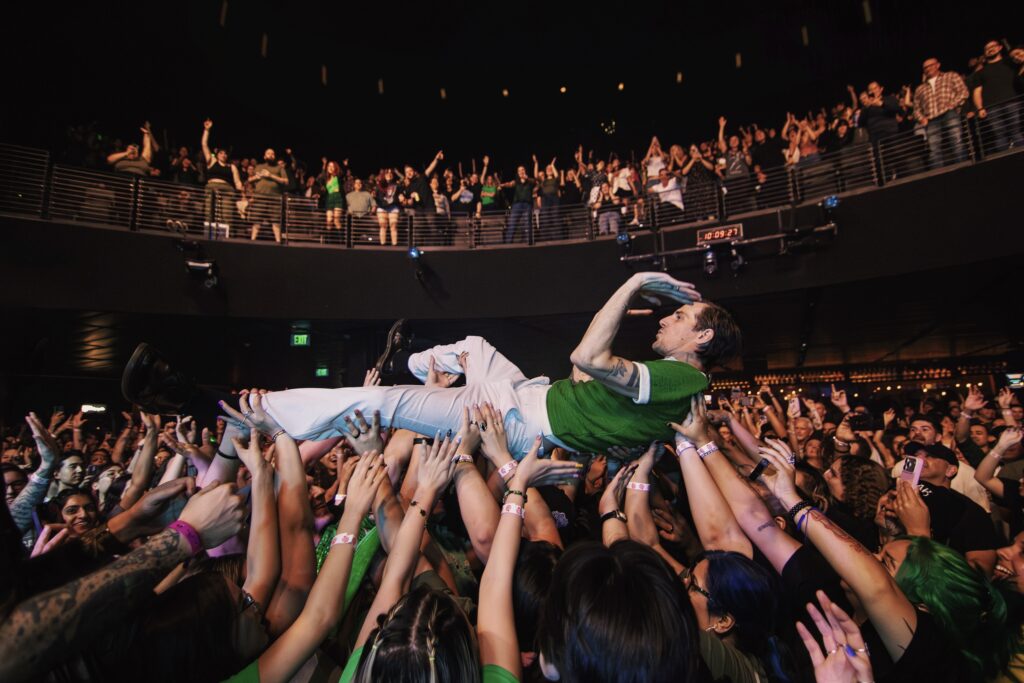
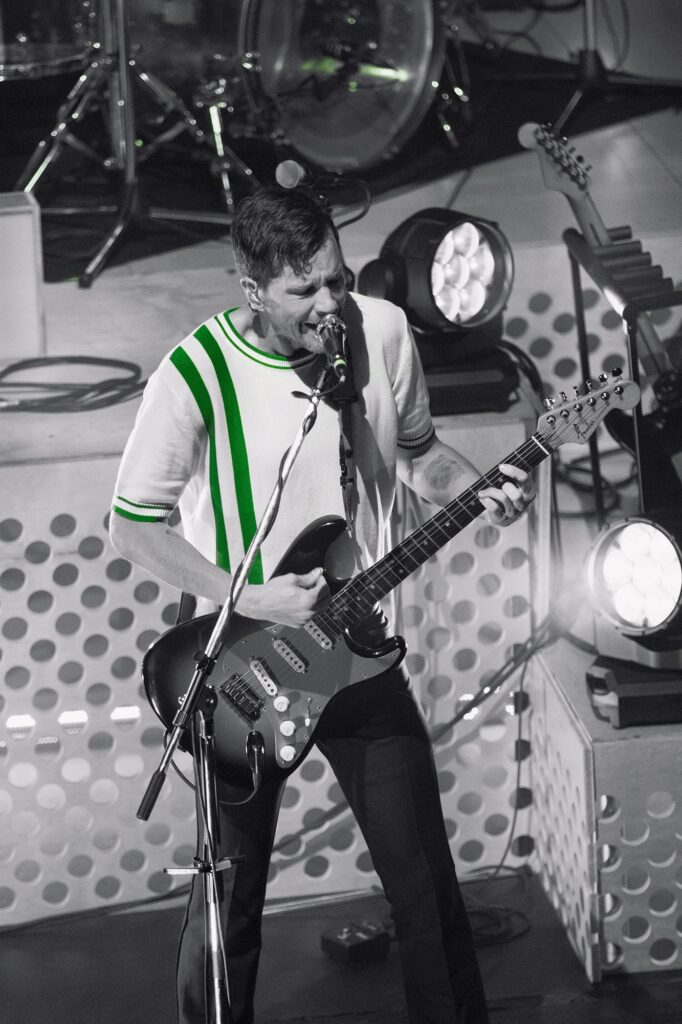
Ahead of their Los Angeles show last month, First III No Flash caught up with The Maine for their electric performance downtown at The Novo. We later chatted with bassist Garrett Nickelsen about growth, perspective, longevity, and the band’s tenth studio album, Joy Next Door.
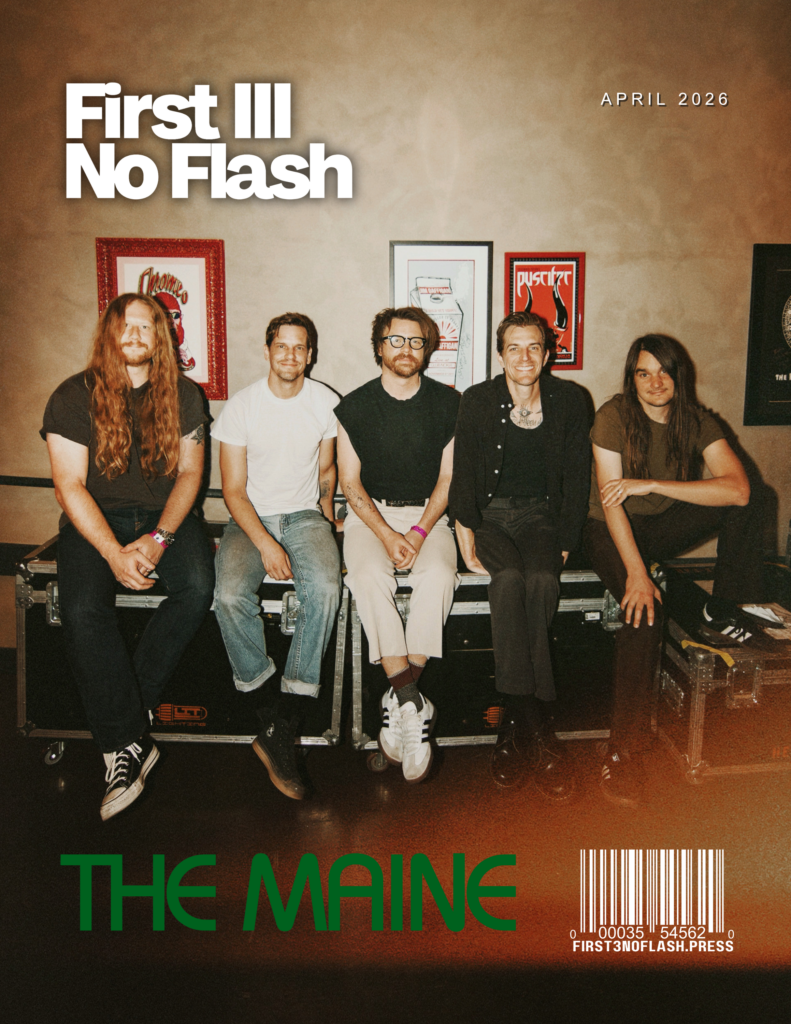
For a band now approaching two decades together, my conversation with Garrett carried the kind of warmth only time can create — reflective, nostalgic, grateful — yet still inspired and excited for what lies ahead. While many artists from the mid-late 2000s MySpace boom now exist mainly through nostalgia, The Maine have quietly accomplished something much more difficult: they’ve continued to evolve in real time. Though not always an upward trajectory, they managed to bring their fans forward with them rather than relying on their audience to keep looking back on their earliest days.
There are countless bands tied to the “emo/scene/pop-punk” era (whatever you’d like to call that massive melting pot of MySpace music) whose biggest moments remain frozen in the years that first introduced them. The Maine never seemed particularly interested in becoming one of those stories. Garrett spoke candidly about the fact that they were never necessarily the biggest band in their scene either — however, they were able to endure by focusing less on external validation and more on simply continuing to create.
“We were never the biggest band in our scene, but we were always able to just keep kind of going.”
Garrett also notes they were really good at putting their heads down and tackling what they wanted to do and how they wanted to do it. That mentality has become one of the defining reasons the band finds itself in such a unique position today. Nearly twenty years in, The Maine are still headlining bigger rooms, drawing more passionate crowds, and releasing music that resonates deeply enough to stand beside — or even above — those day-one songs that introduced them to many listeners in the first place.

For Garrett, one of the most surreal parts of this chapter was watching newer songs ignite crowds in ways that challenge the typical lifecycle of a long-running band. Many well-established bands spend years trying to balance fan demand for older material while convincing audiences to care about what’s new on the horizon. The Maine have somehow sidestepped that seemingly unavoidable trap.
“We’re 18 or 19 years in, and we’re playing the biggest shows we’ve headlined. People are still excited about our last album and seem really excited about this new record [‘Joy Next Door’] that comes out this week.”
It truly is a rarity these days to see a band whose audience does not check their phones when throwing new music onto the setlist, but actually celebrates it. That kind of special relationship is both cultivated and earned through consistency, trust, and a refusal to coast down memory lane over and over.

Of course, longevity in music rarely arrives without turbulence — Garrett was honest about the reality that every career moves in waves. The Maine have experienced enough highs and lows to understand and accept that neither lasts forever. He reflected on periods when trends shifted, the scenes changed, and the band’s place within it all felt less certain. Instead of treating those moments as endings, they learned to see them as seasons. “You have to realize it’s a wave,” he said. “There’ll be high moments and low moments, and we’ve hit them all at this point.” The confident steadiness in the way he speaks suggests that age has not dulled his — nor the band’s — ambition so much as refined it. The expectation and urgency of proving themselves to keep up in the industry has been outweighed by the assurance and reminders of why the band even started creating in the first place.
That mature shift in mindset is deeply embedded in Joy Next Door, a record Garrett described bluntly and honestly:
“This record was really fucking hard to make.”
Not because it was album number ten (though reaching double digits certainly carries symbolic weight for any artist), but because the process demanded more patience, more vulnerability, and more clarity than expected. The band initially believed the album might move in a more electronic direction after releasing “Touch,” a sleek and dance-forward single that hinted at one possible path which almost felt like a soft nod to the electronica wave that infiltrated MySpace at one point. But then, another song entered the picture and changed everything.

Garrett recalled hearing “It’s Not Over Yet,” now the second-to-last track on the album, and immediately recognized that the project needed to pivot.“It was so not that,” he said of the song’s contrast to their earlier direction [with “Touch”] — “But almost instantly all of us were like, ‘No wait, that’s the thing.'”
What followed was a creative reset that led the band somewhere that felt flourishing and emotionally expansive. More piano entered the process. More acoustic textures emerged. These songs began carrying a different kind of weight. Sessions that were expected to wrap by late summer stretched all the way into December — an extended timeline that often signals either chaos or intricate care. In this case, it sounded like both somehow coexisted as the band entered their homestretch to finishing the album. Sometimes it is those records that take the longest to finalize that bring out the most from the artists creating them through a certain time — and Joy Next Door is exactly that kind of album.

One of the most defining choices behind the record was the decision to write and record in sequential order, allowing the album to develop as a story rather than simply a collection of songs. Garrett explained that before recording, the band spent time discussing movie arcs: how films build tension, where emotional climaxes belong, and why endings often need space to breathe after the biggest moment has passed. Instead of treating the final track as an extravagant fireworks finale, they adopted a more cinematic approach — letting that emotional peak arrive before the close and allowing a comedown afterward. “It’s arced in a way that is more set across a movie theme than it is what you would think of as an album,” he said. That touch gives Joy Next Door a genuine sense of storytelling and the feeling of traveling through an experience rather than merely sampling moments from it.

Thematically, much of the album anchors its roots in the strange emotional terrain of adulthood — the realization that life can feel both fuller yet further away from what once defined your younger self. Garrett spoke about conversations surrounding frontman John O’Callaghan now living only streets away from where he grew up — revisiting familiar spaces now through the lens of parenthood, responsibility, and time. He reflects on what John’s life as a father looks like now: “The park where you once played as a child now becomes the park where you bring your own children. The streets that shaped your youth remain the same while you have become entirely different.”

Garrett related to those feelings himself, describing the experience of reaching your mid-30s and confronting what he declared,“the death of my youth.” He clarified that it is not necessarily sadness, but an awareness that some eras of life can only exist as memory:
“There’s things I wish I could go relive because they were so fun and exciting, but if you kept living that way, it’d be so depressing.”
That sentiment may be the emotional center of Joy Next Door. It is not a record mourning youth or the past, nor one pretending adulthood comes without compromise. Instead, it shines a light on the challenges of finding happiness inside the life you actually live now, rather than the one nostalgia tries to sell back to you. While there is maturity in that perspective, there is also a balance of healthy nostalgia and acceptance. With Joy Next Door, The Maine offers a record shaped by adulthood without being weighed down by it—one that understands time moves quickly, identity changes often, and joy sometimes appears not in the distance, but quietly beside you, waiting to be noticed.
The literal sound of Joy Next Door moves with a calm confidence — the kind of record that never needs to force its emotions to make them felt. Across its runtime, The Maine drift between wistful reflection, dreamy textures, subtle melancholy, heartache, and moments of uncertainty, yet the album consistently finds its way back to something reassuring. Even in its heavier emotional turns, there is an underlying warmth to the songwriting that suggests everything will eventually be okay. It is a mature and deeply human listen, one that understands life rarely moves in straight lines. Personal standouts include “Half A Spark,” a feel-good rush made for road trips with the windows down, while “Palms” lands as one of the album’s most emotionally charged moments, elevated by the mantra-like pull of“don’t think, let it happen.”

Mid-way through, the title track “Joy Next Door” feels like stepping into a world of nostalgic orchestration moving in slow motion. “Die To Fall” arrives with a climactic lift and upbeat pulse, carrying some of that same energy hinted at on their earlier release of “Touch.” Toward the end, “It’s Not Over Yet” balances light melancholy with the kind of hopeful optimism and encouragement that lingers long after it ends. The closing track “And Then” serves as the perfect ending credits score — wrapping the album with grace and quiet finality.

Every era of The Maine has long carried its own visual identity — and this one arrived in green. Garrett recalls the color was something he and Pat had discussed early on, more of a feeling than a calculated branding exercise. In the studio, he would even subtly reinforce the mood by changing the artwork on a frame television to paintings filled with dark green tones, almost planting the idea subconsciously in the room. Then came an accidental confirmation: the demo for the opening track was originally titled “New Green,” later shortened to “Green.” “It was just an accident that felt perfect,” Garrett says. Green feels fitting for an album centered around nostalgic suburbia, growth, renewal, movement, and the uneasy beauty of becoming.
Even the album title itself came together almost as organically, too. Joy Next Door arrived later in the process, after much of the instrumentation had already been recorded and lyrics were beginning to take shape. The phrase was thrown out and immediately stuck. What made it resonate was not one singular meaning, but the fact that it could hold many. Joy could be an emotion, a person, a memory, a place, or something still being searched for. It could be literal or symbolic. Rather than define it too rigidly, the band embraced the openness and allowed listeners room to project their own lives into it.

That generosity of spirit has always been central to The Maine, particularly in the way they treat the people who have supported them for years. Few bands have built a fan community quite like theirs — something perhaps most visible through their infamous 8123 Fest. Garrett describes those weekends as some of the moments when it truly hit him that the community had become something larger than the band itself. “It feels like it’s for everyone else now,” he said. “They get to hang out with their friends that they don’t see all the time, and we just happen to be the music for that weekend.” The Maine may be the reason many people first arrived, but the relationships formed around the music have taken on lives of their own.
That same fan-first mindset also explains why the band has resisted some of the increasingly transactional practices that now dominate live music culture. In an era of exorbitant VIP packages and monetized access, Garrett spoke openly about how uncomfortable it feels to place a massive price tag on human connection — something all of the guys have been vocal about from the very start of their careers. While acknowledging the financial realities artists face, he made it clear that some lines simply do not feel right to cross. That principle has helped preserve a certain level of trust and down-to-Earth feeling that many acts struggle to maintain as they grow.
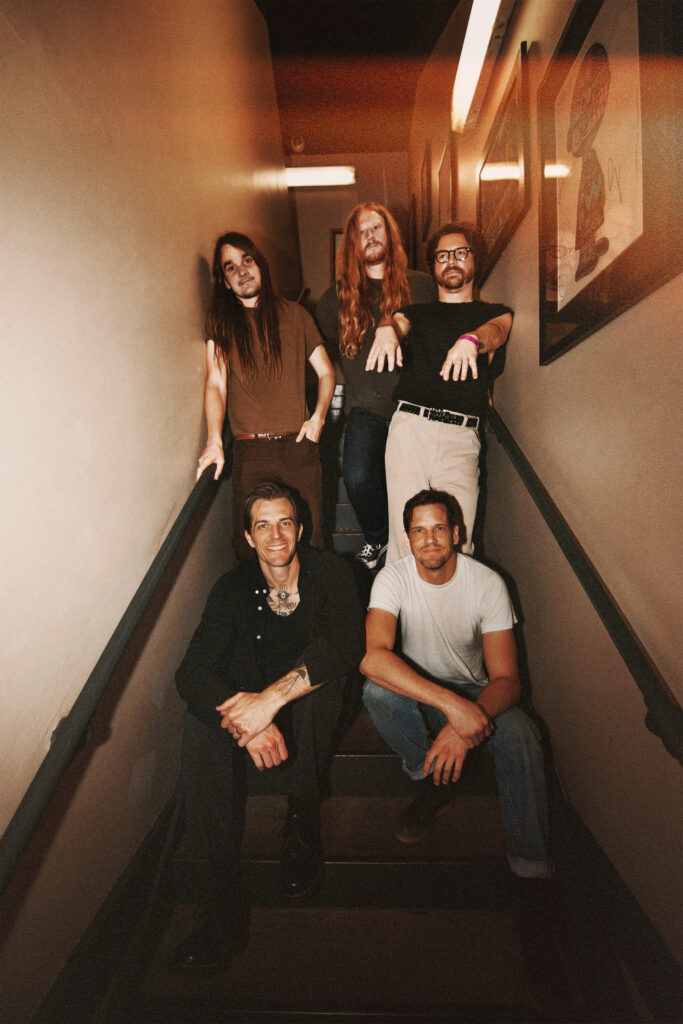
As for what comes next, Garrett spoke with the same mix of gratitude and momentum that defined the entirety of our conversation. More touring lies ahead (including Europe later this year), future headline dates, and the looming reality of a twentieth anniversary celebration that still sounds surreal even to them. Yet still, nothing about The Maine feels like a band preparing for a retrospective lap. If anything, Joy Next Door is just your friendly neighbors knocking to bring you some freshly baked cookies and remind you that life is going to be quite alright.
Photographed and written by Nikki Phillips